



Why Rest Is Preparation: The TCM Approach to Evening and Sleep
We've got the morning conversation mostly figured out. Cortisol, caffeine, the body clock, the first hour. There's no shortage of advice about how to start your day.
The evening is quieter. Less optimised. Treated mostly as a wind-down from the day rather than a practice in its own right.
Traditional Chinese Medicine sees the evening differently.
In TCM, rest isn't the absence of activity. It's an active biological process — one that requires the right conditions to happen properly, and one that determines the quality of energy available to you the following morning. How you end your day is inseparable from how you begin the next one.
This is the philosophy behind Sunset. And it starts with understanding what rest actually is in TCM terms.
The Evening Sequence on the Body Clock
Just as the morning has its organ sequence — Large Intestine, Stomach, Spleen — the evening has its own, and it's equally precise.
5pm to 7pm: Kidney Time
The Kidneys hold a special place in TCM. They are the seat of Jing — the foundational essence that governs vitality, reproduction, and the pace at which we age. They are also the root of both Yin and Yang in the body: the cooling, nourishing, restorative force and the warming, activating, motivating force respectively.
The 5 to 7pm window is when Kidney energy peaks. In TCM, this is a natural signal to begin transitioning away from output and toward restoration. Gentle movement, warm food, quieting the mind. The Kidneys respond well to warmth, stillness, and nourishment — and poorly to late-night stimulation, stress, and cold.
If you regularly feel a second wind of energy around 6pm that keeps you alert long past when you wanted to sleep, TCM would look here first.
7pm to 9pm: Pericardium Time
The Pericardium in TCM is sometimes called the Heart Protector. It governs the emotional and relational aspects of the Heart — joy, connection, and the ability to open and close appropriately to the world around you.
This window is understood as a time for gentle connection, winding down emotionally, and beginning to release the tensions of the day. Screens, stimulating content, difficult conversations, and work left unfinished all tax the Pericardium during this window — keeping the emotional and nervous system activated when it's trying to shift gears.
9pm to 11pm: Triple Warmer Time
The Triple Warmer — sometimes called the Triple Burner — is one of TCM's more complex concepts. It governs the relationship between the body's three energy centres: the upper (heart and lungs), middle (digestion), and lower (kidneys and reproductive organs). Its job in the evening is essentially thermoregulation and the final transition into sleep preparation.
This is the window TCM identifies as optimal for being in bed, if not already asleep. The body is consolidating warmth, completing digestion, and preparing the conditions for deep rest. Stimulation during this window — caffeine consumed earlier in the day with its 5 to 6 hour half-life, bright light, late eating — disrupts this consolidation process directly.
11pm to 1am: Gallbladder Time
If the Triple Warmer is about preparation, the Gallbladder is about execution. In TCM, the Gallbladder and Liver work together during the late night hours to process the day — physically, emotionally, and energetically. The Liver's peak runs from 1 to 3am.
Being asleep by 11pm isn't arbitrary in TCM. It's timed to allow the Gallbladder and Liver to do their work undisturbed. Chronic late nights are understood to deplete Liver Blood and Gallbladder Qi over time — contributing to poor sleep quality, vivid dreams, waking between 1 and 3am, irritability, and the particular exhaustion that doesn't resolve with more hours in bed.
What Yin and Yang Have to Do With Sleep
Daytime is Yang time — active, outward, warm, expansive. Nighttime is Yin time — restorative, inward, cool, consolidating. Sleep is the body's deepest Yin state.
The transition from day to evening is a transition from Yang to Yin. And like most transitions, it works better when it's gradual rather than abrupt.
Most modern evenings work against this transition. Bright screens emit light that suppresses melatonin and signals Yang to the brain. Stimulating content — news, social media, demanding conversations — keeps the nervous system in an outward, reactive state. Late eating asks the digestive system to stay active when it's trying to consolidate. Caffeine consumed in the afternoon or evening blocks adenosine receptors that would otherwise be building the sleep pressure needed to fall and stay asleep.
The cumulative effect is a body that reaches bedtime still running in Yang mode — wired, alert, unable to fully cross into the Yin state that deep sleep requires.
TCM's evening practices are all oriented toward the same goal: supporting the Yang-to-Yin transition so the body can enter rest fully rather than incompletely.
What Incomplete Rest Actually Costs
This matters more than most people realise — and TCM has always understood it in terms that Western sleep science is now confirming.
In TCM, deep sleep is when Qi is replenished, Blood is nourished, and Jing is conserved rather than spent. It's when the body processes the emotional residue of the day, consolidates learning, repairs tissue, and resets the systems that generate energy tomorrow.
Poor sleep — whether from difficulty falling asleep, waking in the night, or sleeping light rather than deep — isn't just tiredness the next morning. In TCM's framework, it's a failure to replenish. Every night of incomplete rest means the next day begins from a lower baseline. Over weeks and months, the deficit accumulates in exactly the way Jing depletion does: slowly, quietly, and in ways that feel like permanent personality traits rather than correctable patterns.
The exhaustion that feels like who you are is often just unresolved sleep debt compounded over time.
Why Sunset Exists
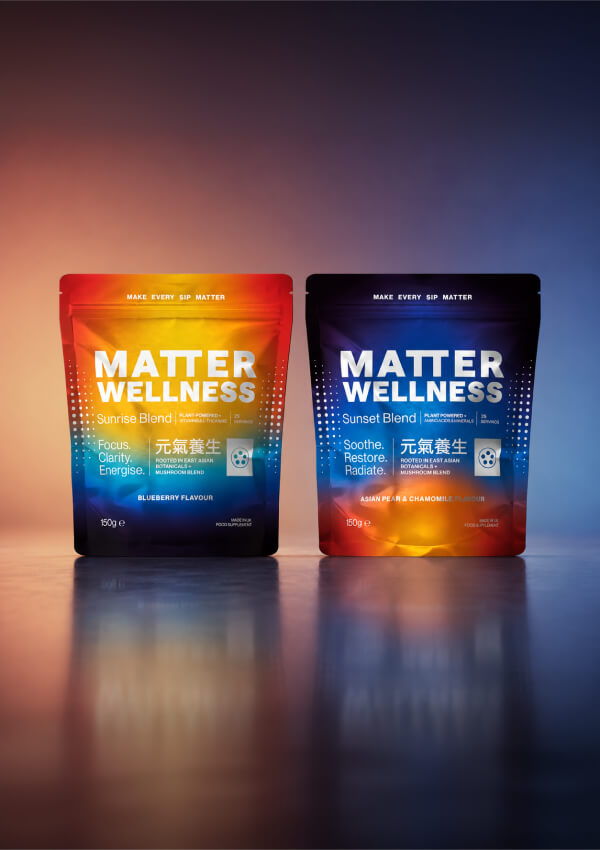
Sunset was formulated for the Yang-to-Yin transition.
Not to sedate. Not to force sleep before the body is ready. But to support the conditions that allow the transition to happen naturally — gently lowering the activation of the nervous system, supporting the Liver and Kidney Yin that TCM associates with the capacity for deep rest, and creating a ritual that signals to the body that the day is genuinely ending.
The herbs in Sunset were chosen for this specific function. Adaptogenic herbs that help regulate the stress-response system — lowering the cortisol that, when chronically elevated into the evening, prevents the Yin state from fully arriving. TCM herbs with a long history of use for calming Shen — the spirit or mental presence that, when unsettled, manifests as racing thoughts, restless sleep, and waking in the night. Functional mushrooms that support the nervous system's shift toward restoration.
No sedatives. No melatonin in doses that override the body's own production. No dependency that leaves you worse without it than you were before.
Just support for something the body already knows how to do — when the conditions are right.
A Different Way to Think About Your Evening
The most useful shift TCM offers on the evening isn't a protocol. It's a reframe.
Rest isn't what happens when you stop. It's something you move toward. Something that requires a transition, a winding down, a gradual shifting of state. The quality of your sleep is shaped as much by the two hours before bed as by anything that happens after you close your eyes.
An evening that honours this looks different for everyone. But in TCM terms, it involves warmth over cold, stillness over stimulation, nourishment over depletion, and a genuine slowing — not a collapse into the couch with a screen, but a conscious movement toward Yin.
Sunset is part of that movement. A warm drink taken in the evening, as part of a transition rather than as a last-minute fix. Working with the body clock rather than against it. Preparing the ground for the rest that makes tomorrow possible.
Because in TCM, how you rest tonight is how you rise tomorrow.
[ SHOP SUNSET → ] ← link to Sunset product page [ SHOP SUNRISE → ] ← link to Sunrise product page