

Why Sunrise Has No Caffeine - And Why That's the Point
Every morning, before you've reached for anything, your body is already waking itself up.
In the first 30 to 60 minutes after you open your eyes, cortisol rises sharply. Not the stress cortisol you've heard about — this is something different. It's called the cortisol awakening response, and it's your body's own built-in alarm system. It promotes alertness, mobilises energy, and prepares your brain for focus. It peaks, then tapers gradually across the morning.
It's calibrated specifically to you. To your sleep, your biology, your needs that day.
Most of us drink coffee straight into the middle of it.
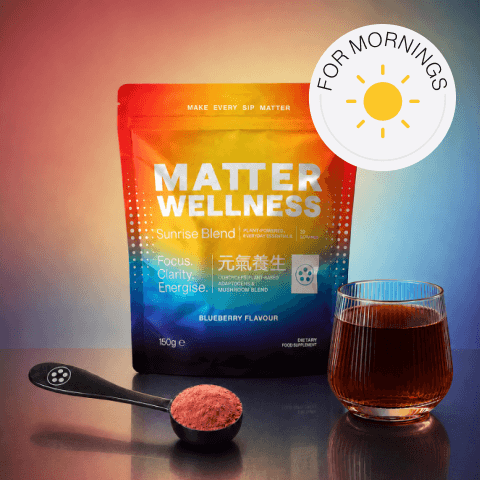
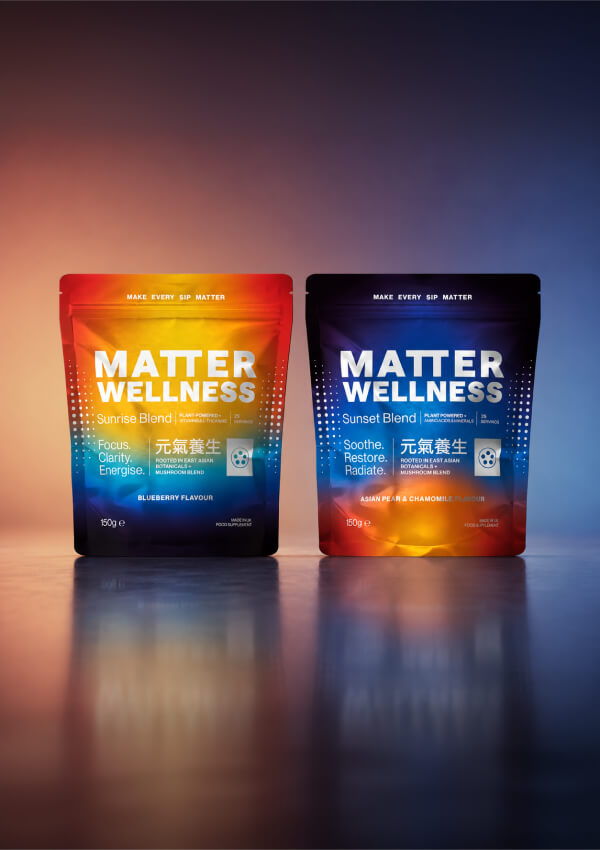
At Matter, this is exactly why we kept caffeine out of Sunrise — our daytime blend. Not because caffeine doesn't work. But because the way it works runs directly counter to what Sunrise is designed to do. Here's the full picture.
What Caffeine Is Actually Doing
Caffeine works by blocking adenosine — a chemical that builds up in your brain throughout the day and creates the feeling of tiredness. It's a healthy, necessary signal. Your body telling you it needs rest.
Caffeine doesn't remove that signal. It covers it. The adenosine keeps accumulating behind the blockade, and when the caffeine clears — usually 5 to 6 hours later — it floods back all at once. Harder than it would have arrived naturally. That's the crash. Not a side effect. The mechanism.
But there's something quieter happening too.
Research shows that after just five days of regular morning caffeine, the cortisol awakening response becomes significantly blunted. Your body stops producing its own wake-up signal, because caffeine has been doing it instead. The internal system stands down.
Remove the caffeine, and you don't just feel the absence of a stimulant. You feel the absence of a system your body has quietly stopped running on its own.
This is why some mornings feel impossible without coffee. It's not a personality trait. It's physiology.
The TCM Version of the Same Story
Traditional Chinese Medicine arrived at a parallel understanding thousands of years before the science.
In TCM, stimulants are understood to borrow energy from your deepest reserves — what's called Kidney Qi. The energy they produce isn't generated from within. It's drawn forward from the future, from a finite store that governs vitality, recovery, and the pace at which we age.
There's a classical concept called Jing — often translated as essence. Think of it as the wax and wick of a candle. Qi is the flame. The light that radiates outward is Shen — spirit, presence, clarity of mind. How you live determines how fast the candle burns.
Stimulants, in this framework, turn up the flame. They don't add more wax. And they make you think you have more light than you do.
TCM's approach to energy works on an entirely different principle. Rather than pushing the system, tonic and adaptogenic herbs nourish it. They support the Spleen Qi that transforms food into usable energy. The Kidney Qi that governs deep vitality. The Liver Qi that keeps energy circulating rather than stagnating. The result isn't a surge. It's a steadier, more reliable baseline — built over time rather than borrowed against it.
What About Matcha?
It's a fair question. Matcha has a real story — the L-theanine alongside caffeine does produce a calmer kind of alertness compared to coffee. That's genuine biochemistry, not marketing.
But matcha was never a TCM ingredient. It's a Japanese ingredient, developed through Japanese tea ceremony culture, and its wellness narrative — the sustainable energy, the ancient wisdom — was built retrospectively in the West, around an ingredient that still contains a stimulant. The cultures it came from never positioned it as medicine.
We noticed. And we didn't want to repeat that pattern.
Matter was built on actual TCM lineage — herbs with real historical therapeutic use, formulas developed with practitioners in Hong Kong. Adding matcha because it has a wellness story felt like exactly the thing we were trying not to do.
Why We Made Sunrise Caffeine-Free
Sunrise was formulated to work with the morning your body was already having.
Warming herbs that gently support digestion as the Stomach and Spleen reach their peak activity window between 7 and 11am — a timing that maps directly onto the cortisol awakening response. Adaptogens that help regulate the stress-response system over time rather than spike it. Functional mushrooms that support sustained mental clarity without the ceiling that comes with dependency.
No crash. No comedown. No system quietly switching itself off in the background.
Caffeine borrows energy from tomorrow. Sunrise doesn't.
A Note on the Reset
If you're someone who drinks caffeine every morning and the idea of changing that feels significant — it probably is. The withdrawal is real, and we won't pretend otherwise. It peaks within 20 to 48 hours and resolves for most people within a week.
After that, adenosine receptors normalise. The cortisol awakening response recalibrates. Sleep deepens. The mornings that once felt impossible without coffee start to feel different — not because something has been added, but because the body has remembered how to do it on its own.
That's what Sunrise is for. Not to replace one dependency with another. To support the space where your body can find its own ground again.
If you're curious what a caffeine-free morning actually feels like, Sunrise is a good place to start.