



What Is Jing? The TCM Concept That Changes How You Think About Vitality
There is a concept in Traditional Chinese Medicine that stops people when they first hear it. Not because it is complicated. Because it rings true in a way that is hard to explain.
The concept is Jing.
Jing is often translated as Essence, but that does not quite capture it. A better way to think about it is this: Jing is the finite reserve of vital energy you are born with. It is the deep resource that underlies everything, your stamina, your reproductive capacity, your ability to age well, your resilience under pressure. And unlike Qi, which is replenished every day through food, sleep, and breath, Jing cannot be topped up in the same way. Once it is spent, it is spent.
That is the part that tends to land quietly.
Where Jing comes from
In TCM, Jing has two sources. The first is Prenatal Jing, the essence you inherit from your parents at conception. This is the constitutional energy you are born with, and it determines your baseline vitality, the strength of your constitution, and in part how you age. Some people are born with a more abundant Prenatal Jing. Others start with less. Neither is a moral failing. It is simply the hand you are dealt.
The second source is Postnatal Jing, a smaller daily replenishment that comes from the food you eat, the air you breathe, and the rest you take. This Postnatal Jing does not replace what you spend from your deeper reserves, but it does support them. Think of it as interest earned on a savings account: meaningful, worth protecting, but not the principal itself.
The Kidneys are considered the home of Jing in TCM. When practitioners talk about Kidney Qi or Kidney essence, they are often speaking in part about the health and fullness of your Jing reserves. Strong Kidney energy in TCM is associated with vitality, strong bones and teeth, healthy hair, clear hearing, and sexual health. All of which, if you look at them together, describe what we tend to recognise as ageing well.
What depletes Jing
Here is where modern life and TCM converge in uncomfortable ways.
Jing is depleted by excess. Not the occasional late night or difficult week, the body is designed for those. But chronic excess: years of poor sleep, sustained overwork, emotional burnout without recovery, excessive stimulants, skipping meals, pushing through illness rather than resting. These patterns draw down from the reserve rather than the daily replenishment. Over time, the reserve shrinks.
TCM also identifies specific patterns as particularly costly.
Chronic stress without recovery is one of them. The body under sustained stress draws on deeper reserves to maintain function. In TCM, this is understood as the system borrowing from Jing when its other resources are insufficient. Modern endocrinology tells a parallel story: chronic cortisol dysregulation accelerates cellular ageing in measurable ways.
Stimulant-driven energy is another. When the body's natural Qi is not sufficient and you reach for caffeine to bridge the gap, you are creating an energy response without an underlying energy resource to support it. TCM would understand this as borrowing from a deeper reserve to produce a surface effect. Done occasionally, the body adapts. Done habitually over years, it leaves a mark.
Reproductive and creative output without replenishment also matters here. TCM has traditionally associated significant creative output, childbearing, and sustained sexual activity with Jing expenditure, not because these things are harmful, but because they draw from the same reserve. The implication is not abstinence but replenishment: adequate rest, nourishment, and recovery to balance what is spent.
Irregular sleep is another significant factor. The hours between 11pm and 3am correspond to the Gallbladder and Liver in the TCM body clock, a window when the body does its deepest restorative work. Consistently missing this window is considered one of the more significant ways the body fails to replenish what it spends each day. If you want to understand more about the body clock and how it shapes energy, the TCM body clock piece is worth reading.
What conserves Jing
The TCM approach to Jing is less about boosting it and more about not wasting it. This is a meaningfully different orientation from most modern wellness thinking, which tends to frame everything as something to optimise upward.
The practices that conserve Jing are, in most cases, unglamorous: consistent sleep, warm and nourishing food particularly in the morning when the Stomach and Spleen are most active, gentle movement rather than exhausting exercise, emotional steadiness rather than constant stimulation, and building in real recovery rather than treating rest as something that happens when everything else is done.
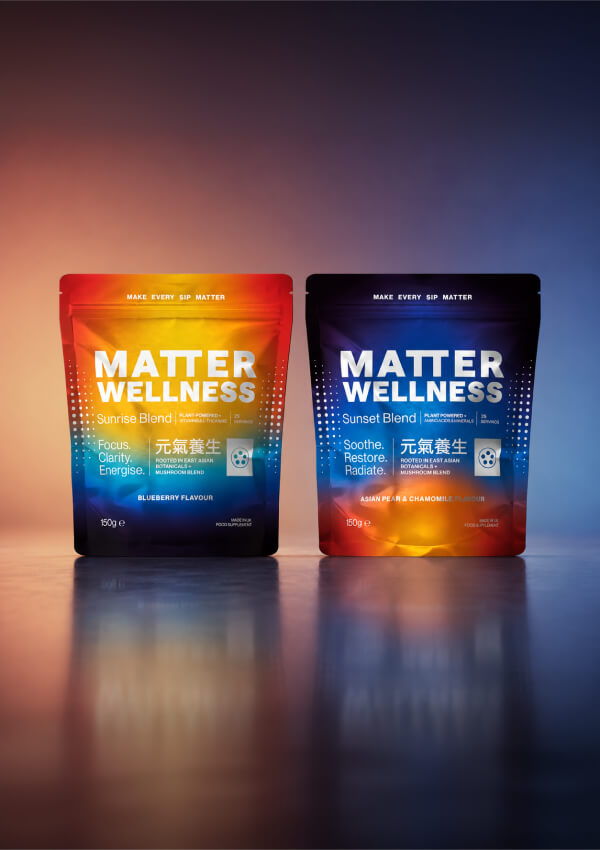
There is a reason TCM practitioners have always emphasised the morning routine. How you begin the day determines how much you draw on deeper reserves throughout it. A morning that begins with warm nourishment, unhurried movement, and calm engagement with the day requires less from the system than one that begins with a cold stimulant, a rushed commute, and high-demand cognitive work before the body has had a chance to arrive. This is part of why Sunrise was formulated the way it was, not to spike energy, but to support the system's own capacity to generate it sustainably.
Certain herbs have a long tradition of Jing support in TCM. He Shou Wu, Rehmannia, and Cordyceps are among those classically associated with nourishing the Kidneys and supporting Jing reserves. These are tonic herbs. They work slowly, cumulatively, and as part of a broader pattern of care rather than as quick fixes.
Jing and how you age
One of the most striking aspects of Jing theory is how accurately it describes the observable differences in how people age. We have all met someone in their sixties who seems younger than their years, and someone in their forties who already seems depleted. TCM would attribute a significant part of that difference to how carefully or carelessly their Jing was managed across their life.
This is not determinism. The hand you were dealt matters, but so does how you play it. Someone born with a smaller constitutional reserve who lives carefully may age more gracefully than someone with abundant Jing who spent it recklessly.
And this is where the concept becomes genuinely useful, not as something to worry about, but as a reframe. When TCM asks how your Jing is doing, it is really asking: how are you treating your long-term reserves? Are you consistently spending more than you are restoring? Is your current pace of life sustainable over a decade, or are you borrowing from the future to fund the present?
Most of us know the answer at some level. We feel it in the quality of our energy: whether it is deep and steady, or whether it has a brittle, caffeinated quality that requires constant maintenance.
Jing in relation to Qi and Shen
Jing is one of the Three Treasures in TCM, the foundational substances that together constitute health and vitality. The other two are Qi, the dynamic circulating energy that powers moment-to-moment function, and Shen, the spirit or mind associated with mental clarity, emotional steadiness, and sleep.
The three are deeply interconnected. Strong Jing supports robust Qi generation. Good Qi supports clear Shen. And the reverse is also true: when Jing is depleted, Qi tends to be thin, and Shen tends to be disturbed, manifesting as poor concentration, anxiety, restless sleep, or a vague sense of mental fog.
Understanding Qi gives you the context for how energy moves and functions day to day. Jing gives you the context for where that capacity comes from, and how to protect it across a lifetime.
A different way of thinking about vitality
Most modern approaches to energy are about the present. How do I feel right now? How do I get through today? How do I perform at the level this situation demands?
Jing asks a different question. How are you building for the long term? What does your energy look like at sixty? Are the choices you are making now ones that will compound positively, or ones that you will eventually pay for?
This is not a reason for anxiety. It is an invitation to take the long view, to treat rest as productive, to approach nourishment as a daily investment rather than an afterthought, to reconsider whether the stimulants bridging your energy gaps are serving you or slowly costing you something you cannot easily replace.
TCM does not promise that you can reverse years of Jing depletion overnight. But it does offer a clear framework for stopping the drain, and that is often the most important first step.
If you are thinking about evening rest and restoration as a practice rather than just a necessity, Sunset was formulated with that in mind, supporting the body's natural winding-down process so that the hours of deep rest actually do their restorative work.